 Big Cartel
Improving Signup Without a Rearchitecture
A signup change quietly confused sign-in. The judgment call wasn't whether to fix it, it was choosing the fix that solved the problem without derailing everything else.
At a glance
- Challenge
- After we removed shop URL and shop name from signup to enable Google and Apple sign-in, duplicate account creation spiked well above baseline.
- Approach
- Shipped targeted UX fixes (email detection on the shop URL field, a forgot-shop-URL recovery flow, and a link to it from forgot password) instead of alt proposal account-switcher.
- Outcome
- Duplicate account creation, which had spiked to 13% of signup volume, dropped back below the 4% baseline.
- Role
- Principal Product Manager
- Timeline
- October 2025 to June 2026
Two years of removing friction, one field at a time
Big Cartel's sign-up flow required a shop subdomain, a shop name, an email, and a password. The subdomain was uniquely awkward for a store platform: your subdomain is also your login for Big Cartel, not your email — a twenty-year-old architectural decision we still live with today. Sellers who didn't have a shop name ready, or who kept hitting "subdomain taken," dropped out of signup.
The subdomain-taken problem was worse than it should have been because Big Cartel historically never deleted accounts except for legal reasons. Old, dormant, unpaid accounts sat there for years, locking up desirable subdomains — things as generic as soap.bigcartel.com — that new sellers wanted.
“Did you mean…?” prompts for common email domain typos.
Millions of locked subdomains freed up.
Auto-generated from shop name, randomized when taken.
Subdomain auto-generated from email, with a dashboard callout.
Duplicate account spike detected — and fixed.
“Did you mean…?” prompts for common email domain typos.
Millions of locked subdomains freed up.
Auto-generated from shop name, randomized when taken.
Subdomain auto-generated from email, with a dashboard callout.
Duplicate account spike detected — and fixed.
From legacy form to social login
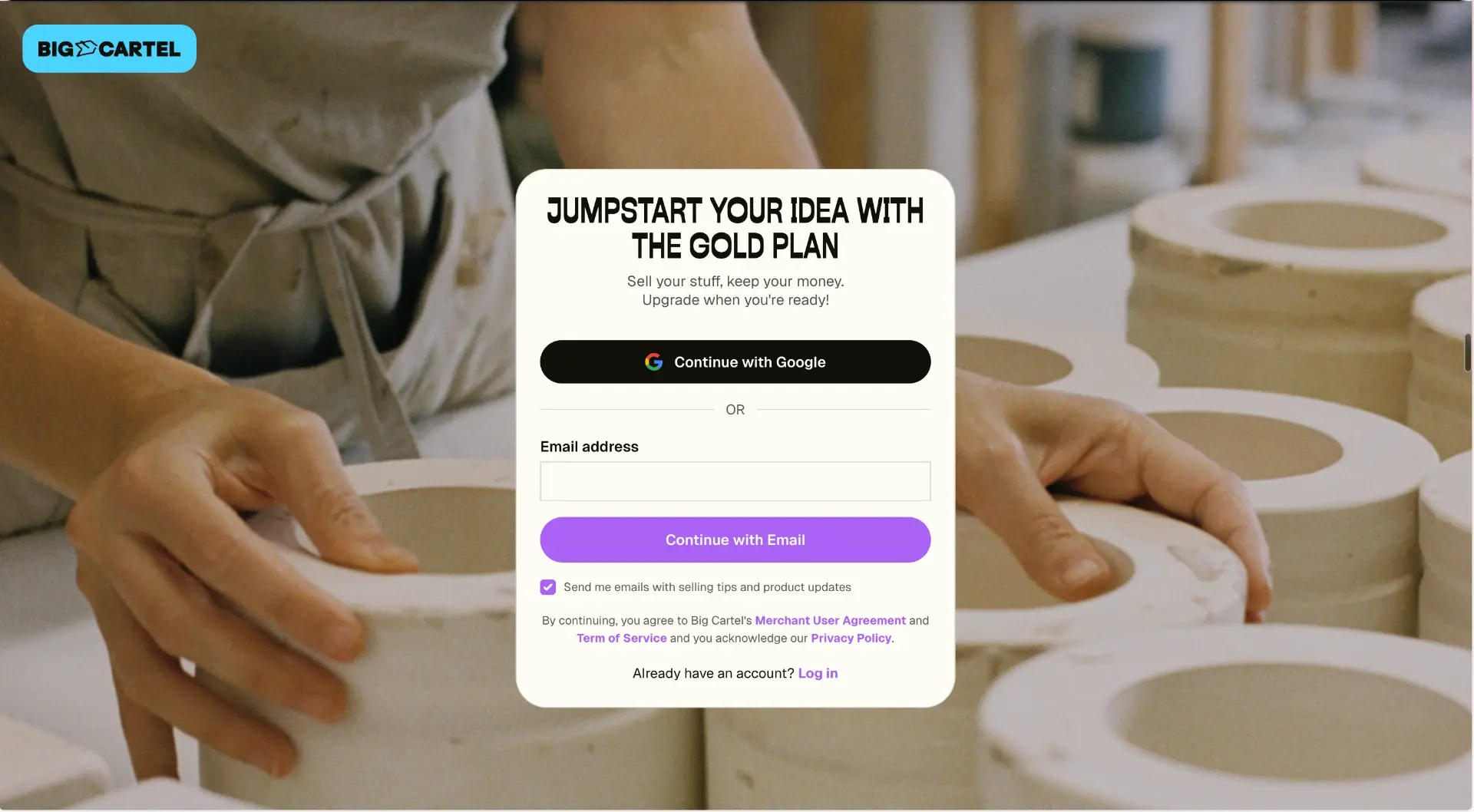
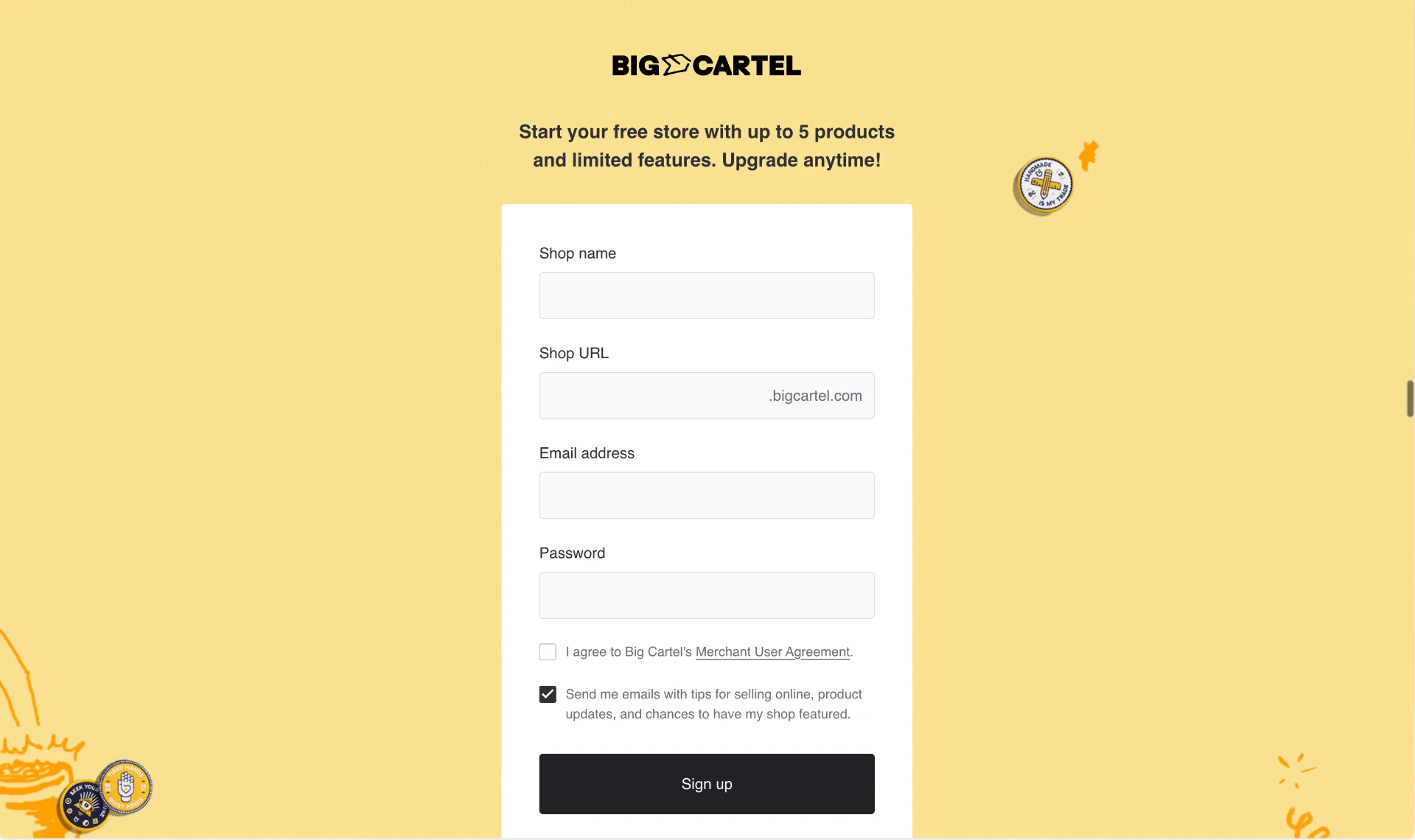
Drag the slider to compare the original form (left) with the social-login version (right).
The three changes that set the stage for the duplicate-account spike.
+3.5pp lift over the 53% baseline.
+0.8pp completion, with a much larger share of sellers later editing their shop name or subdomain.
Social login accounted for nearly half of new accounts.
CS flagged a spike
We made these changes gradually and deliberately between 2023 and 2026, watching the metrics at every step. But in 2026, after social login shipped, Customer Support started flagging a spike in reports. Around the same time, Voice of Customer submissions mentioning account or login problems rose, and we saw a rise in the number of accounts being created under the same email address in a short window.
Duplicate accounts created per day, Jan 2025–Apr 2026. We counted a "duplicate" as a new account whose email matched an existing account created within the previous 90 days. Volume stayed low through most of 2025, then climbed sharply after the subdomain field was removed from signup in late 2025 and peaked in early 2026.
We'd always had a baseline level of duplicate account creation. Some sellers intentionally run more than one shop under the same email, and some sellers legitimately forget how they log in and create a new account rather than recover the old one. The question wasn't whether duplicate accounts would ever hit zero, it was whether this was still that baseline or something new.
Two ways to fix a 20-year-old decision
Once we saw the spike, the root cause wasn't really a mystery to name at a high level: a Big Cartel account's login is the shop subdomain, not an email address or username, a decision made twenty years ago that the whole system was still built around.
One faction of the team pushed hard to use this moment to fully re-architect signup and sign-in around email as the account identifier. That is probably the more correct long-term fix. But it wasn't simple: we had millions of existing accounts built on the old system, plus an already-established baseline of sellers who intentionally run multiple shops under one email. Rebuilding login around email would mean building an account switcher so those sellers could move between shops, plus a real migration path for every legacy account, and it would take weeks if not months to do properly.
At the time, the team's priority was paid subscriber growth, and we were mid-flight on a set of other experiments in the same area of the product. So the harder, more correct fix went on the roadmap, and I went looking for what we could do immediately.
Finding the root cause
The initial theory was that something in the social login handoff was creating orphaned records. Rather than accept that, I went and read the actual Voice of Customer entries.
One seller's complaint was that when they tried to login they got the error "shop does not exist." That phrasing was specific enough to reproduce. I opened the sign-in form, typed an email address into the shop URL field, and got back exactly that error. That was the smoking gun: the sign-in flow still asked for a shop URL that sellers no longer consciously set or remembered, because signup had stopped asking for it.
Walking the flow surfaced a second gap. Forgot Shop Password required already knowing your shop URL — and because URLs were now auto-generated rather than chosen, many sellers had never registered what theirs was, even after receiving it by email. There was also no "Forgot Shop URL" flow at all. A seller who couldn't recall their URL had no supported path back into their own account, so creating a new one looked like the only option.
What we shipped instead
The engineer who had proposed the account switcher pushed back hard on the lighter-weight approach. I built the case to leadership that, given current roadmap priorities, the incremental fix was the right call — and that it bought us time to design the account-switcher migration properly later rather than rushing it under pressure from an active incident.
My designer used AI tooling to move fast on the shop-URL detection fix specifically, prototyping and helping ship a production-ready version within about an hour. That speed is part of why the team could resolve this in days rather than committing to the multi-week rebuild path.
Email detection on the shop URL sign-in field
If a seller types something that looks like an email address into the shop URL field, we now show a specific message pointing them to the right field instead of the generic "this shop does not exist." This was the exact error surfaced in the Voice of Customer report, and the fastest fix to ship.
A new Forgot Shop URL flow
Enter your email and we send you the shop URL(s) associated with it. Before this, there was no recovery path at all — a seller who couldn't remember their URL had no supported way back into their account.
A link to Forgot Shop URL from Forgot Password
A seller who can't find their password usually can't find their URL either, so Forgot Password now points them to both recovery paths in one place.
What changed after the fixes shipped
A low baseline rate of same-email duplicate accounts persists by design — some sellers intentionally run multiple shops under one email — so the fix was never expected to bring the number to zero.
Key Takeaways
The sign-up work did what it was supposed to do. The spike that followed taught us more about how flows fail than the wins did about how they succeed.
Removing a field on one side of a flow can silently break the other.
Signup and sign-in are coupled even when they feel like separate flows. Simplifying one without auditing the other created a UX contradiction: we stopped asking for a shop URL, then kept demanding it to log in. To sellers, that read as data loss.
The Voice of Customer tool is a diagnostic instrument, not just a complaint log.
The literal wording of one support message — "this shop does not exist" — was the clue that cracked the investigation, because it was specific enough to reproduce. Aggregate ticket counts would never have pointed at the field; the raw sentence did.
The right scope of a fix depends on what the team is mandated to do right now.
A more architecturally correct solution — account switcher, unified login — was real and worth doing eventually. Shipping the lightweight version protected the team's growth roadmap while still solving the seller-facing problem, and it bought time to scope the bigger migration properly instead of rushing it under pressure.
More case studies
Rebuilding Big Cartel's discount engine to drive merchant adoption and conversion.
An AI-powered system that surfaced product problems hidden in thousands of seller messages.
Five experiments that built the case for a trial-first acquisition model.
A 17-skill AI system that processed 20,000+ pages of discovery and took the document-dump tactic off the table.
A photo and voice-first renovation punch list where AI does the filing and the app serves three tasks a day.
How solving a missing draft-product state and a decade of one-off themes shipped Big Cartel's strongest upgrade driver.